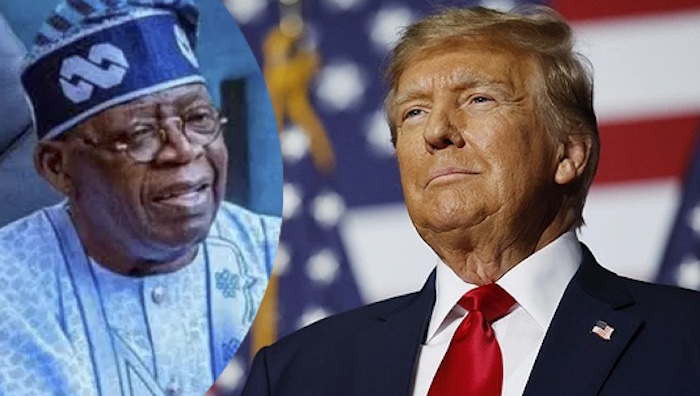
In a striking diplomatic endorsement, U.S. President Donald Trump has praised Nigerian leader Bola Ahmed Tinubu for his “decisive leadership” in confronting terrorism, as the two nations deepen their security partnership amid growing instability across West Africa.
Trump’s letter, dated July 6, 2026, and released today by the Nigerian Presidency, represents one of the most explicit US presidential acknowledgements of Nigeria’s counter-terrorism efforts in recent years.
The correspondence follows a series of coordinated military operations that have dealt significant blows to extremist networks in the region.
“Thank you for your thoughtful letter. Your kind words mean a great deal to me, and I appreciate your decisive leadership on behalf of the Nigerian people,” Trump wrote, specifically applauding Tinubu’s resolve “to tackle the issues plaguing your nation, especially the violence affecting Christian communities.”
The language marks a notable departure from the more measured diplomatic tone typically employed in US-Nigeria communications, reflecting what appears to be a genuine strategic convergence between the two administrations.
The burgeoning security alliance has produced tangible results. Most significantly, the May 16 coordinated assault on ISIS hideouts in the Lake Chad basin resulted in the elimination of the group’s top leader, Abubakar Al-Minoki, and numerous senior commanders.
The operation, which involved joint Nigerian and US intelligence assets, has been described by security analysts as one of the most successful counter-terrorism strikes in the region’s recent history.
The cooperation extends beyond kinetic operations. In November 2025, the two presidents agreed to establish a Joint Working Group co-chaired by their respective National Security Advisers, creating a framework for training, intelligence sharing, and joint operational planning.
Trump’s letter makes explicit reference to the deployment of US Special Operations Forces, describing them as “among the most elite military units anywhere in the world.”
They have been tasked with equipping Nigerian armed forces with “the skills, tools and intelligence they need to protect your homeland.”
The strengthened partnership comes at a critical juncture. The Sahel region continues to grapple with overlapping security crises, with extremist groups exploiting governance vacuums and ethnic tensions to expand their influence.
Nigeria’s Christian communities have been particularly vulnerable, with attacks on churches, clergy, and rural farming villages escalating in recent years. The Plateau region has witnessed some of the worst violence, where the boundaries between banditry, herder-farmer conflicts, and extremist insurgency have become increasingly blurred.
Trump’s specific reference to “Christian communities” suggests a White House focus on religious freedom concerns, a priority that has featured prominently in American foreign policy discourse.
Last week’s visit to Abuja by US Assistant Secretary of State for Africa, Frank Garcia, underscored the deepening relationship. Garcia held high-level meetings with senior Nigerian officials and pledged to expand cooperation beyond security into economic and development areas.
The visit also focused on the implementation of the US-Nigeria 2026 Defence Cooperation Roadmap, which Trump characterised as “a robust framework” for confronting terrorism “in all its forms.”
“The United States-Nigeria relationship is crucial at a time where conflict has spread across West Africa and around the world,” Trump wrote, a sentiment that appears to be reciprocated by Nigerian officials.
The letter concludes with Trump expressing anticipation for “continued discussions over the course of my Presidency,” suggesting the security partnership will remain a cornerstone of bilateral relations.
For President Tinubu, the endorsement represents a significant diplomatic achievement, reinforcing his administration’s narrative of effective governance and international engagement. It also signals continued US commitment to supporting Nigeria’s security forces despite competing global priorities.
The Nigerian Presidency, through Special Adviser Bayo Onanuga, confirmed receipt of the letter and described it as testament to the “flourishing relationship” between Abuja and Washington DC.