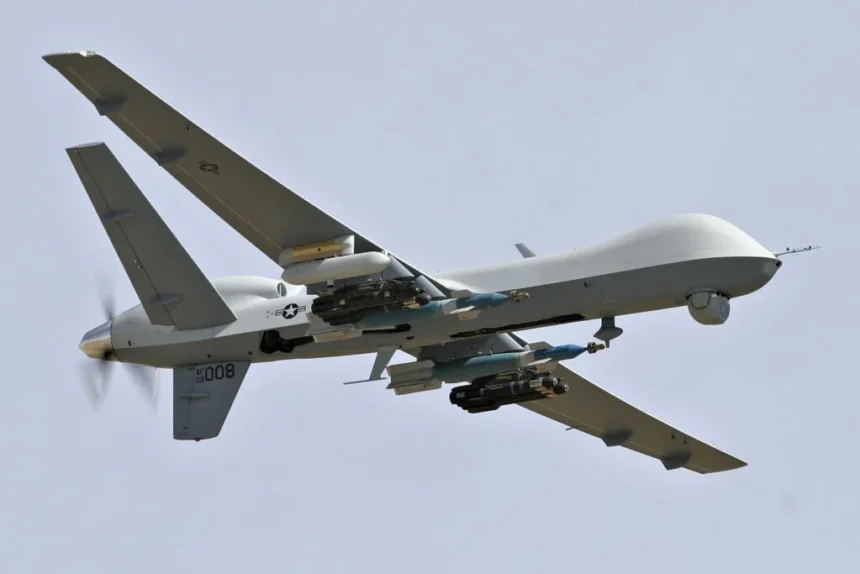
The United States has quietly deployed multiple MQ-9 Reaper drones and approximately 200 troops to Nigeria, marking a recalibrated return to West African counterterrorism efforts focused on intelligence sharing and training rather than direct strikes, according to U.S. and Nigerian officials.
The deployment, which includes assets operating from Bauchi airfield in the northeast, comes nearly two years after the U.S. military withdrew from a major drone base in neighbouring Niger following a junta’s demand for Western forces to leave.
Reuters reports that, that closure had left a significant intelligence gap in the Sahel, where Islamist insurgencies linked to Islamic State and al Qaeda have been spreading southward toward Gulf of Guinea states.
Unlike the 2024 Niger operation, which involved about 1,000 troops and a $100 million facility focused on regional surveillance, the new Nigerian mission is explicitly limited in scope.
U.S. officials said the Reapers are collecting intelligence only and are not authorized for airstrikes, while American personnel are operating in a strictly non-combat role, embedded apart from Nigerian frontline units.
“We see this as a shared security threat,” a U.S. defense official said, speaking on condition of anonymity.
The official emphasized that the deployment was requested by Nigeria and is designed to bolster the Nigerian military’s own capabilities against militant groups that have confounded its forces for nearly two decades.
Major General Samaila Uba, director of defense information at Nigeria’s Defence Headquarters, confirmed that U.S. assets are operating from Bauchi and that the support is channeled through a newly established U.S.-Nigeria intelligence fusion cell.
“This support builds on the newly established U.S.-Nigeria intelligence fusion cell, which continues to deliver actionable intelligence to our field commanders,” Uba told Reuters.
“Our U.S. partners remain in a strictly non-combat role, enabling operations led by Nigerian authorities.”
The arrangement signals a deliberate shift in Washington’s approach. Late last year, the U.S. carried out airstrikes in northwest Nigeria on Christmas Day, which it said were aimed at stopping attacks on Christian communities—a characterization Nigeria’s government and regional analysts have disputed as an oversimplification of complex local conflicts. The new posture emphasizes sustained intelligence partnerships over episodic lethal action.
MQ-9 Reapers, capable of loitering at high altitude for more than 27 hours, offer a dual capability for surveillance and precision strikes. By limiting their use to intelligence collection, U.S. officials appear to be navigating both Nigerian sovereignty concerns and the political sensitivities that led to the expulsion of Western forces from Niger, Mali, and Burkina Faso in recent years.
That regional realignment has created new security risks. Militants have intensified attacks in northwest Nigeria, near the borders with Benin and Niger, where longstanding banditry is increasingly converging with Islamist insurgency. On March 16, suicide bombers struck a garrison town in the northeast—a reminder that Boko Haram and its Islamic State-allied offshoot, ISWAP, retain the ability to hit urban centers after 17 years of conflict.
“We continue to assess that these organisations will seek opportunistic targets and may attempt to demonstrate relevance through high-visibility attacks,” Uba said, noting that the March 16 assault remains under investigation.
The United States has long been a security partner to Nigeria, providing training, weapons sales, and counterterrorism assistance.
But the new deployment reflects a more direct, if constrained, operational involvement. Uba said the timeline for the U.S. presence would be determined jointly by both governments, with no fixed endpoint set.