By Amofokhai Williams
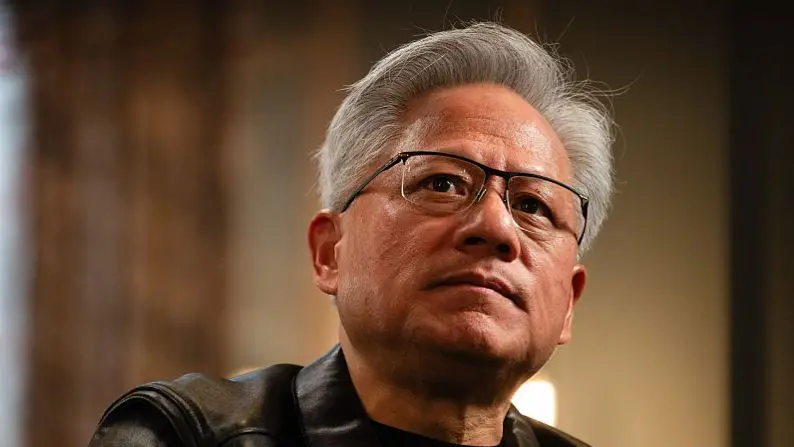
Jensen Huang, co-founder and chief executive of American technology giant Nvidia, has resigned from his leadership positions following a damaging controversy involving allegations of two extramarital affairs, triggering a sharp decline in the company’s share price.
Nvidia’s board of directors announced Huang’s resignation on Thursday, November 12, bringing an end to his leadership of the company he co-founded in 1993 and transformed into one of the world’s most valuable technology businesses.
The development came amid mounting pressure following reports that Huang had been involved in a second alleged affair with an executive within Nvidia, days after he admitted to being unfaithful in a separate relationship with a woman reportedly linked to Chinese espionage.
The controversy has unsettled investors, with Nvidia shares falling sharply in pre-market trading before plunging more than 13 per cent after the United States stock market opened.
The decline wiped more than $500 billion off the company’s market capitalisation, highlighting the financial implications of the leadership crisis at a company central to the global artificial intelligence industry.
Huang, 63, had led Nvidia for more than three decades, overseeing its transformation from a graphics processing chip manufacturer into a dominant supplier of advanced processors powering artificial intelligence systems, cloud computing and data centres.
The company, valued at more than $4 trillion before the controversy, has become a major beneficiary of the global race to develop increasingly sophisticated artificial intelligence technologies.
In announcing the resignation, Nvidia’s board acknowledged Huang’s enormous contributions, describing the company as one of the most consequential technology businesses in the world.
“Jensen’s contributions to Nvidia are profound,” the board said, thanking him for his immeasurable contributions to the company and the wider technology industry.
Colette Kress, Nvidia’s executive vice-president and chief financial officer, has been appointed interim chief executive.
Kress, who joined Nvidia in September 2013, has played a significant role in managing the company’s finances during its extraordinary expansion.
Before joining Nvidia, she spent nearly 25 years in finance positions at major technology companies, including Cisco and Microsoft.
In her first reaction to the appointment, Kress pledged to maintain the company’s growth trajectory and technological leadership.
“Nvidia’s strength has always come from its people, and together with our leadership team, I am committed to building on the extraordinary foundation Jensen created over the last 33 years,” she said.
She added that the company would continue advancing its work in accelerated computing and artificial intelligence while maintaining its focus on customers, partners, developers and shareholders.
The controversy began after Huang admitted on Sunday to having an affair with a woman reportedly associated with another company, with subsequent reports alleging that the woman was connected to Chinese intelligence.
The New York Times subsequently reported a second alleged affair involving an executive within Nvidia, further intensifying scrutiny of the company’s leadership.
The allegations have also raised national security concerns because of Nvidia’s strategic importance in the global semiconductor industry and the geopolitical tensions surrounding advanced chip exports to China.
Beijing has warned Washington against using the espionage allegations as justification for renewed restrictions on technology sales to China.
Chinese Foreign Ministry spokesperson Mao Ning said Beijing remained willing to work with the United States to reach common understandings, as the two countries seek to manage tensions over access to advanced semiconductor technology.
The controversy comes at a sensitive time for Nvidia, which is expected to announce its latest financial results next Tuesday.
Market analysts say the leadership transition could create short-term uncertainty, although the company’s dominant position in the artificial intelligence chip market remains a major strength.
Nvidia accounts for approximately six per cent of the S&P 500, meaning movements in its share price can have a significant effect on the broader American stock market.
Investment director at AJ Bell, Russ Mould, warned that many ordinary investors could be exposed to the company’s fortunes through their pension investments, even without directly owning Nvidia shares.
Technology and artificial intelligence editor Zoe Kleinman observed that Huang’s departure was particularly surprising given his central role in building Nvidia into a global technology powerhouse.
She noted that Kress would have to reassure investors that the company’s operations, innovation and expansion plans would continue without the founder at the helm.
Despite his resignation, Huang’s influence over Nvidia may not disappear immediately. Before stepping down, he owned more than 870 million shares, representing slightly over 3.5 per cent of the company’s total stock, according to a June filing with the US Securities and Exchange Commission.