By Amofokhai Williams
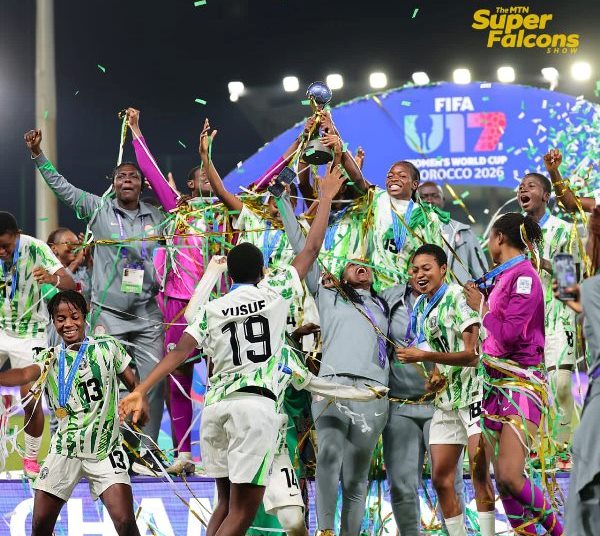
Nigeria’s Flamingos have conquered the world, defeating Japan 2-1 in the final of the 2026 FIFA Under-17 Women’s World Cup in Rabat, Morocco, to win the country’s first title in the competition and become the first African nation to lift the trophy.
The victory on Saturday, November 7, 2026, marks a landmark achievement for Nigerian and African women’s football, ending years of continental attempts to win the global youth championship.
Two goals from Awawu Bashiru and Oluebube Umejiaku secured the historic triumph for the team coached by Akeem Busari, while Japan’s late response through Fuki Ito set up a tense finish before Nigeria held on for victory.
The Flamingos began the final with attacking intent, putting Japan under pressure and creating opportunities before finally breaking the deadlock in the 39th minute.
Bashiru opened the scoring after receiving a pass from Mary Dunstan. Her effort slipped through the hands of Japanese goalkeeper Kou Kadowaki and found the net, giving Nigeria a deserved 1-0 lead at half-time.
The Nigerian girls returned from the break with renewed determination and doubled their advantage just two minutes into the second half.
Esther Stephen launched a long pass forward, which Umejiaku controlled with her left foot before calmly lifting the ball over the advancing Kadowaki in the 47th minute.
The goal put Nigeria firmly in control at 2-0 and brought the team closer to a historic world title.
Japan, however, refused to surrender. The Asian side intensified its attacks and reduced the deficit in the 80th minute when Fuki Ito finished a move created by Anri Ito.
The goal changed the complexion of the encounter, with Japan pressing aggressively for an equaliser as the final minutes approached.
The Flamingos were forced to defend resolutely but also threatened on the counter-attack through Umejiaku and Kanyinsola Yusuf.
Japan came close to drawing level through Mashiro Yamaji, but Nigeria survived the late pressure, with its defence standing firm through five minutes of added time.
When the final whistle sounded, the Nigerian players erupted in celebration, having secured a title that had eluded every African country since the competition began.
Umejiaku’s contribution was particularly significant. Beyond scoring the decisive second goal, she was named Player of the Match for her performance in the final.
The triumph completed one of the most remarkable turnarounds in the Flamingos’ World Cup history.
Nigeria’s campaign had begun with a 2-1 defeat to Poland in the group stage, raising questions about the team’s prospects in the tournament.
But Busari’s girls recovered impressively, defeating Puerto Rico 2-0 before producing a significant 3-1 victory over defending champions North Korea.
That result ended North Korea’s 18-match unbeaten run in regulation time at the tournament and announced Nigeria as serious contenders for the title.
The Flamingos maintained their momentum in the knockout rounds, overcoming Mexico 2-1 in the Round of 16, with Umejiaku and Dunstan finding the net.
They subsequently edged Venezuela 1-0 in the quarter-finals, thanks to Azeezat Oduntan’s 89th-minute penalty, to reach the last four.
Their biggest statement came in the semi-final against Brazil, where Nigeria secured a convincing 3-1 victory to qualify for its first-ever final.
Queen Joseph opened the scoring in the 56th minute before Bashiru struck twice in the 71st and 80th minutes. Brazil managed a late consolation, but the Nigerian team held on to book its place in the championship match.
The team’s recovery from its opening defeat was also a product of the psychological work undertaken by the technical crew.
Before the final, Busari explained that psychological support, renewed confidence and adjustments to the players’ approach helped them overcome the disappointment of losing their first match.
Captain Harmony Chidi had also described reaching the final as a dream achievement, saying lifting the trophy would be a moment the players, coaches and the country would cherish.
The team’s preparation had received an additional boost from its success at the 2026 WAFU-B U-17 Girls Cup in Côte d’Ivoire, where Nigeria won all five matches, scoring 17 goals and conceding only once.
A new chapter for African women’s football
Nigeria’s victory is significant beyond the country’s borders, as it makes the Flamingos the first African team to win the FIFA U-17 Women’s World Cup.
The achievement also improves on Nigeria’s previous best performance at the competition, a third-place finish in 2022.
Japan, which won the tournament in 2014 and had finished runners-up in 2010 and 2016, had been seeking another title but could not overcome the determined Nigerian side.
FIFA President Gianni Infantino and CAF President Patrice Motsepe were among the dignitaries who witnessed the final in Rabat.