President Bola Tinubu has urged West African leaders to move beyond rhetoric and act decisively to transform the region’s economic landscape, calling for deeper integration, policy coordination, and investment in human capital.
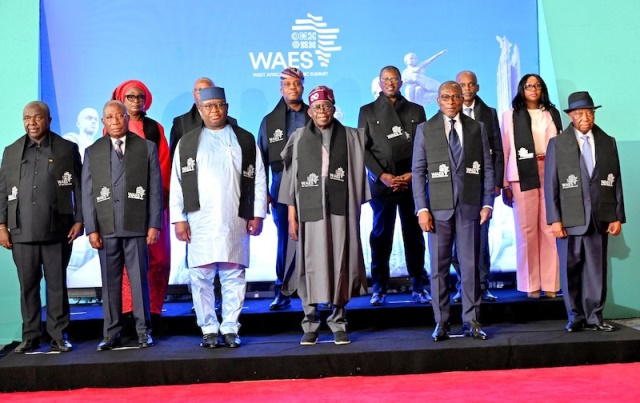
The Nigerian leader made the call on Saturday while delivering the opening address at the inaugural West Africa Economic Summit 2025, held at the International Conference Centre, Abuja.
Speaking in his capacity as Chairperson of the ECOWAS Authority of Heads of State and Government, President Tinubu warned that despite West Africa’s status as one of the world’s last great frontiers of economic growth, opportunity alone does not guarantee transformation.
“Opportunity is not destiny. We must earn it through vision, integration, policy coherence, collaboration, and capital alignment,” he said.
Tinubu lamented the region’s persistently low intra-regional trade—still under 10%—describing it as a “coordination failure,” not a failure of will.
He warned that the global economy will not wait for West Africa to get its act together and stressed the urgency of strengthening regional value chains and investing in critical infrastructure.
“We can no longer afford to compete in isolation or rely solely on external partners. Our future lies in building strong regional supply chains, power networks, and digital frameworks,” he added.
Tinubu also emphasised the importance of leveraging the region’s youthful population, warning that without investment in education, digital infrastructure, and innovation, the demographic advantage could become a liability.
Citing Nigeria’s own investments in youth development, he noted that no single country can succeed alone.
Highlighting regional infrastructure initiatives such as the Lagos-Abidjan Highway and the West African Power Pool, Tinubu said such collaborative projects offer a glimpse of what is possible but insisted that more needs to be done.
“We must move from declarations to concrete deals, from policy frameworks to practical implementation,” he charged.
Touching on Africa’s role in the global transition to green technologies, Tinubu stressed that the region must not repeat the mistakes of previous industrial revolutions.
He called for the end of the “pit-to-port” model of raw material exportation, advocating instead for investment in local processing and regional manufacturing.
“Our rare minerals power tomorrow’s technologies. But it is not enough to be resource-rich; we must be value-chain smart,” he declared.
President Tinubu also underlined the role of the private sector in economic transformation, calling on governments to create the enabling environment for business to thrive through law, order, and market-friendly policies.
He concluded with a rallying call for practical, people-centred outcomes from the summit, including a renewed commitment to intra-regional trade, improved infrastructure, and the creation of real opportunities for West Africa’s youth and women.
“Let us build a West Africa that is investable, competitive, and resilient—one that leads with vision, responsibility, and unity. This is the new West African proposition. Let us make it real. Let us make it bankable,” he said.
The summit brings together heads of state, policy-makers, private sector leaders, and development partners to chart a new path for economic transformation across the region.