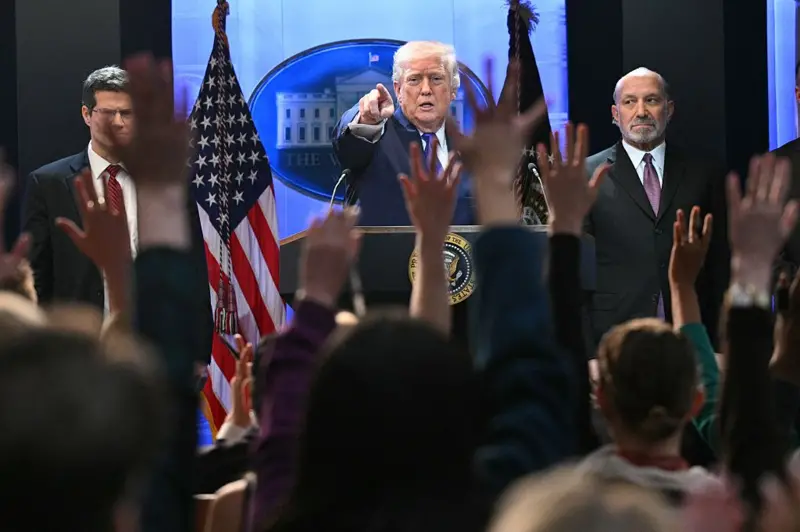
In a defiant and hastily arranged press conference at the White House Friday evening, President Donald Trump moved to immediately circumvent a stinging Supreme Court defeat, announcing the imposition of a 10% global tariff under a different statutory authority just moments after the nation’s highest court struck down his previous trade regime.
The rapid-fire sequence of events, a legal loss followed by an immediate executive counterstrike, plunged U.S. trade policy back into a state of uncertainty, raising immediate questions about the fate of billions of dollars in collected duties and the constitutional limits of presidential power.
The crisis began earlier Friday when the Supreme Court ruled against the White House’s use of the International Emergency Economic Powers Act (IEEPA) to justify sweeping tariffs.
The decision, which Justice Kavanaugh joined in the majority, effectively nullified the legal underpinning for a significant portion of the administration’s “Liberation Day” tariff framework.
Appearing before reporters shortly after the ruling, a visibly agitated Trump labeled the decision “deeply disappointing” and accused the justices of lacking “the courage to do what’s right for our country.”
He singled out the dissenting justices-Thomas, Alito, and notably, his own appointee Kavanaugh, for praise, while dismissing the majority as being “swayed by foreign interests” and wanting to be “politically correct.”
Yet, rather than retreat, the President pivoted. “I’m allowed to destroy a country’s trade, I can embargo a country, I can destroy the trade… but I can’t give them a little fee?”
Trump questioned rhetorically from the podium. “We won’t be doing that.”
Minutes later, he signed a new executive order, pivoting to Section 122 of the 1974 Trade Act. This provision, created during a different era of global trade, allows a president to impose temporary tariffs of up to 15% on imports from all countries to address balance-of-payments deficits.
Crucially, the authority is time-limited; the new 10% duties can only remain in effect for 150 days before requiring congressional approval.
The announcement left a host of critical questions unanswered. When asked whether the billions of dollars in tariffs collected under the now-defunct IEEPA authority would have to be refunded to importers, Trump acknowledged it “has to get litigated,” predicting a legal battle that could last “five years.”
Erica York of the Tax Foundation, who had been analyzing the potential pivot, estimated that the new Section 122 tariffs would replace approximately 56% of the revenue previously generated under the stricken IEEPA measures.
However, the 150-day sunset clause creates a ticking clock for the administration, which must now either negotiate a deal with a skeptical Congress or see the tariffs lapse.
The political fallout was immediate. By publicly stating that the dissenting justices were “happily invited” to his upcoming State of the Union address while the majority was “barely invited,” Trump further inflamed tensions between the executive and judicial branches.
While the White House insists the new tariffs are “effective immediately” and that previously imposed duties remain “in full force,” the rushed shift from IEEPA to Section 122 underscores the fragility of the administration’s trade war architecture.