Lagos State Governor, Babajide Sanwo-Olu has issued a final warning to illegal occupants and traders operating on the median of the Lagos-Badagry Expressway, announcing that a massive demolition and clearance operation will begin next week as part of a broader strategy to restore order, improve environmental sanitation and transform waste management across the state.
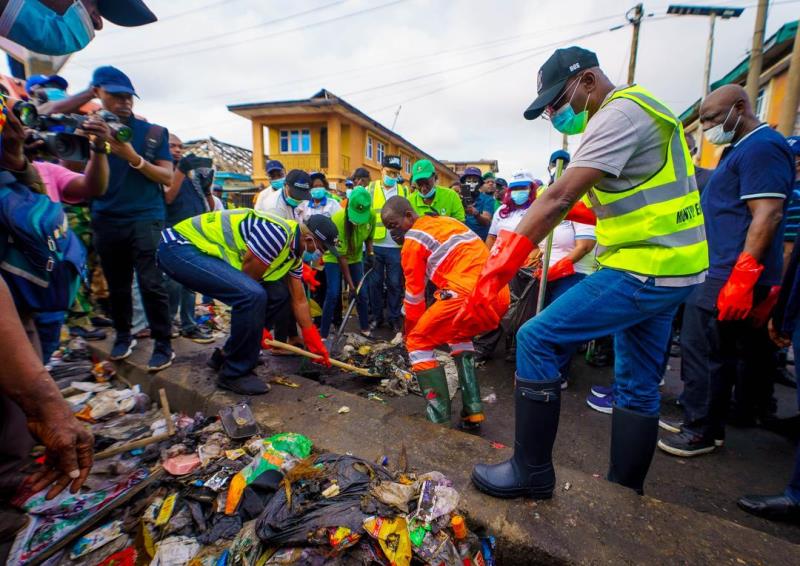
The governor gave the directive on Saturday while addressing journalists during the monthly environmental sanitation exercise at Itire Road in Surulere, declaring that the state would no longer tolerate the illegal occupation of public infrastructure.
Sanwo-Olu said the enforcement exercise would cover the entire stretch from Orile-Iganmu to Okokomaiko, warning that all illegal structures erected on the highway median would be demolished.
“This is the final notice to everyone occupying the median of the Lagos-Badagry Expressway. From next week, we are coming to clear the entire median. Everything there will go. Every illegal structure will be removed,” the governor said.
He described the highway median as a critical component of the Lagos-Badagry Expressway project, stressing that it was never designed for markets, commercial activities or residential structures.
“It is not meant to be a market. It is not meant to be a place where people erect structures. It is a highway median, and we must preserve it, especially considering the huge public investment on that corridor,” he added.
Sanwo-Olu said thousands of enforcement personnel would participate in the operation to ensure strict compliance with environmental and physical planning laws.
“We are coming with all the necessary manpower and equipment. We will remain there until the job is completed. No one should expect any exemption,” he warned.
Beyond the demolition exercise, the governor unveiled fresh measures to strengthen Lagos’ waste management system, revealing that the state had ordered 150 additional waste compactors to improve refuse evacuation, with the first batch expected within the next three months.
He disclosed that smaller compactor trucks were also being procured in partnership with local governments to access inner streets and estates where conventional refuse trucks cannot operate.
Sanwo-Olu further announced that the state was investing in a modern Material Recovery and Recycling Facility capable of processing about 4,250 metric tonnes of waste daily. The facility, expected to commence operations next year, is designed to reduce dependence on landfills by converting waste into reusable materials.
He acknowledged operational challenges facing some Private Sector Participation (PSP) waste operators due to rising operating costs and inadequate equipment but assured residents that government interventions were underway to strengthen their capacity.
The governor appealed to residents to pay their waste collection bills promptly, stressing that efficient waste management requires the cooperation of government, businesses and citizens.
“Waste management is not the responsibility of government alone. It is a collective responsibility. Residents must also play their part by paying for waste collection services,” he said.
Following the sanitation exercise, Commissioner for the Environment and Water Resources, Tokunbo Wahab, led top government officials on an inspection of ongoing construction at the Olusosun dumpsite, where he disclosed that a new Transfer Loading Station with a daily capacity of 2,500 metric tonnes is expected to be completed before the end of the year.
According to him, the facility, being developed by concessionaire Zoomlion, will transfer waste from Olusosun to the state’s Material Recovery Facility in Ikorodu as part of Lagos’ transition from a traditional landfill model to a circular economy driven by recycling and waste-to-energy initiatives.
Wahab said the concessionaire had also committed to rehabilitating the 1.2-kilometre access road to the dumpsite under its Corporate Social Responsibility programme while increasing construction activities to day-and-night operations to meet the completion deadline.
He noted that Lagos could no longer sustain its decades-old “pick-and-dump” waste disposal model, arguing that rapid urbanisation and limited land had made the system obsolete.
“Lagos can’t sustain a linear waste management system. We don’t even have the land for it anymore. Waste must become a resource for wealth, energy and economic development,” the commissioner said.
He highlighted ongoing initiatives under the state’s waste-to-wealth programme, including the supply of combustible waste to Lafarge for industrial energy and the conversion of organic waste from Ikosi Fruit Market into electricity through a biodigester.
Wahab added that the planned recycling and energy projects would significantly reduce the volume of waste ending up at landfill sites while supporting cleaner and more sustainable environmental practices.
Also speaking after monitoring the sanitation exercise in Kosofe Local Government Area, the Head of Service, Bode Agoro, expressed satisfaction with the increasing participation of residents in the monthly environmental sanitation programme.
He urged corporate organisations to emulate companies such as Lafarge by supporting environmental sanitation initiatives through their corporate social responsibility programmes.
Sanwo-Olu reiterated that environmental cleanliness remains one of his administration’s key priorities, urging residents to maintain clean surroundings and instil environmental responsibility in children from an early age to build a healthier and more sustainable Lagos.