By Amofokhai Williams
President Bola Tinubu has declared that Nigeria’s economic reforms are yielding measurable results, assuring that the nation remains firmly on the path of stability, growth, and renewed global confidence.
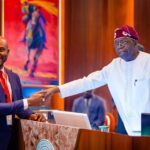
Speaking on Thursday at the Federal Executive Council (FEC) meeting in Abuja, following the swearing-in of two new ministers, Dr Bernard Mohammed Doro (Humanitarian Affairs and Poverty Reduction) and Dr Kingsley Tochukwu Udeh, SAN (Innovation, Science and Technology), the President said his administration continues to strengthen diplomatic and economic relations with global partners.
“The most important thing is that despite political headwinds and public fears, we are engaging the world diplomatically. The success of our $2.3 billion Eurobond, oversubscribed by 400%, is highly reassuring,” Tinubu stated.
“The task ahead is immense, but with unity and purpose, guided by the Renewed Hope Agenda, we will build a prosperous, inclusive, and resilient Nigeria.”
The President, while addressing security challenges, reiterated his commitment to ending terrorism and all forms of criminality in the country.
“Do we have problems? Yes. Are we challenged by terrorism? Yes. But we will defeat it,” he said. “Nigeria is one family, and we shall spare no effort until we eliminate all criminals from our society.”
He also charged ministers and government officials to maintain consistency in their public communication and avoid conflicting messages.
Tinubu directed the Minister of Finance and Coordinating Minister of the Economy, Wale Edun, to brief the Council on the nation’s economic performance.
Edun, in his presentation, said Nigeria’s macroeconomic indicators had significantly improved, describing the second quarter of 2025 as the best economic performance in a decade.
“In Q2 2025, Nigeria’s GDP grew by 4.23%, the highest in ten years outside the COVID rebound. Thirteen sectors recorded growth above 7%, up from nine in the previous quarter. Industrial growth nearly doubled from 3.72% to 7.45%, reflecting rising productivity and investor confidence,” he reported.
He noted that inflation had eased to 18.02% in September, while foreign reserves rose to $43 billion and trade surplus reached ₦7.4 trillion.
“These figures reflect a nation moving from subsistence to productivity and affluence,” Edun said, adding that the vision of achieving a $1 trillion economy by 2030 is attainable through sustained 7% annual growth and a strong anti-poverty drive.
He further noted that Nigeria’s removal from the Financial Action Task Force (FATF) Grey List and positive credit ratings from global institutions demonstrated the growing confidence in Tinubu’s reform agenda.
Edun added that the recent $2.35 billion Eurobond issuance — which attracted over $13 billion in subscriptions-reaffirmed international investor confidence in Nigeria’s economy.
“Despite political headwinds, the market focused on Nigeria’s economic fundamentals, not politics,” he said.
He urged ministries overseeing key sectors, including infrastructure, agriculture, health, mining, education, the blue economy, and digital innovation — to collaborate with state governments in developing projects attractive to investors.
“Every naira must be optimised. Where multilateral funding is limited, we must rely on domestic resources,” Edun said, noting that upcoming reforms would target tariff reviews and the removal of investment barriers to further stimulate growth.