By Amofokhai Williams
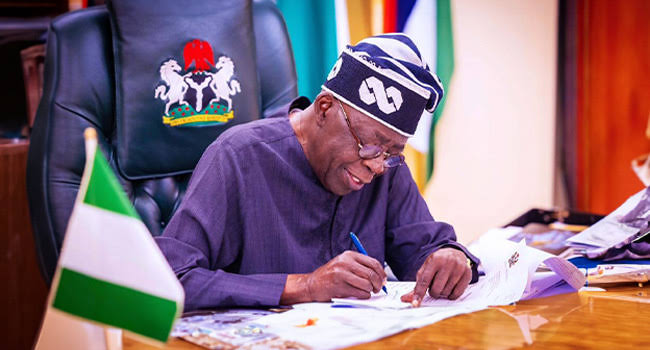
President Bola Ahmed Tinubu has given assent to the 2026 Appropriation Act, approving a total expenditure of ₦68.32 trillion for the fiscal year.
He also signed legislation extending the implementation window for the 2025 budget — specifically its capital component — from March 31, 2026, to June 30, 2026.
The 2026 budget allocates ₦4.799 trillion to statutory transfers and ₦15.8 trillion to debt servicing. Recurrent expenditure is set at ₦15.4 trillion, while the Development Fund for Capital Expenditure receives ₦32.2 trillion. With capital spending representing roughly 50% of the total envelope, the budget signals a strong emphasis on infrastructure, economic stability, national security, and inclusive growth.
This allocation strikes a deliberate balance between unavoidable obligations (debt service and statutory transfers), day-to-day government operations, and productive investments aimed at boosting long-term productivity and improving citizens’ quality of life.
In parallel, the President assented to the Appropriation (Repeal and Enactment) (Amendment) Bill, 2026, which provides the six-month extension for the 2025 capital projects. The move is designed to allow Ministries, Departments, and Agencies (MDAs) to complete advanced-stage infrastructure and development initiatives, improve project delivery rates, and extract maximum value from already appropriated funds.
The 2026 Appropriation Act takes effect from April 1, 2026, enabling the Federal Government to begin full implementation in alignment with the Renewed Hope Agenda.
President Tinubu has directed all MDAs to prioritise discipline, transparency, and efficiency in the use of public resources, with strict attention to value-for-money and timely execution of projects. He commended the National Assembly for its diligence, cooperation, and swift passage of the budget, reaffirming the need for continued synergy between the Executive and Legislative branches to advance national development.
The President further assured Nigerians of his administration’s commitment to deepening fiscal reforms, strengthening revenue generation, stimulating economic growth, creating jobs, and reinforcing social protection programmes.