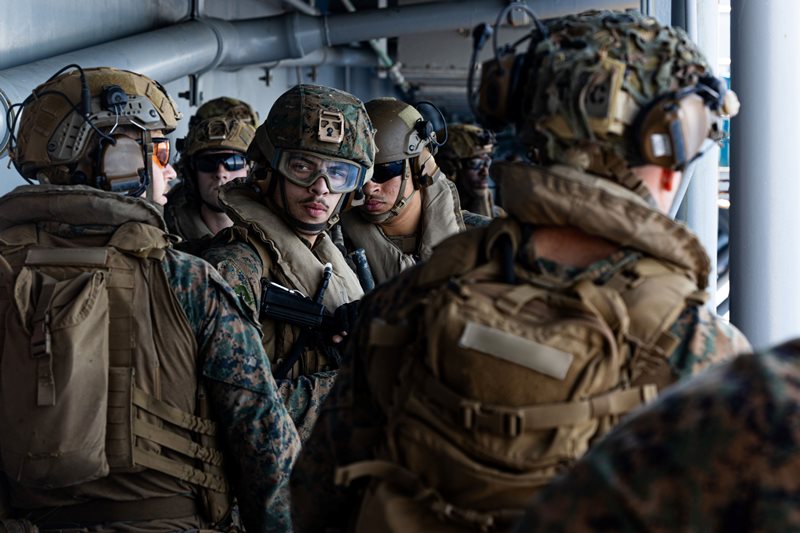
The amphibious assault ship USS Tripoli (LHA 7) entered the U.S. Central Command area of responsibility on March 27, bringing with it a formidable naval presence that includes roughly 3,500 service members, a squadron of strike fighter aircraft, and a full complement of amphibious assault assets.
The deployment, announced by CENTCOM on social media, positions the America-class warship as the flagship for the Tripoli Amphibious Ready Group and the embarked 31st Marine Expeditionary Unit (MEU).
Together, the naval and marine forces represent a highly mobile, self-sustaining strike group capable of rapid response across the region.
The USS Tripoli is the second ship in the America class, a new generation of amphibious assault vessels optimized for operating short‑takeoff and vertical‑landing aircraft, including F‑35B Lightning II Joint Strike Fighters.
Its arrival adds significant aviation and expeditionary warfare capacity to the CENTCOM theater, which spans the Middle East, Central Asia, and parts of South Asia, a region where the U.S. has long maintained a rotating naval presence to deter aggression, protect maritime chokepoints, and support partner nations.
The 31st Marine Expeditionary Unit, based in Okinawa, Japan, is regularly forward‑deployed and specializes in amphibious operations, crisis response, and humanitarian assistance.
The combined force aboard the Tripoli brings with it a mix of tiltrotor aircraft, landing craft, and armored vehicles, providing commanders with flexible options ranging from non‑combatant evacuations to high‑end maritime strikes.
No specific operational plans were disclosed, but the deployment comes as the U.S. continues to monitor tensions in the Gulf of Aden, the Red Sea, and the Strait of Hormuz, where Iranian naval activity and Houthi attacks on commercial shipping have kept CENTCOM forces on heightened alert in recent years.
The Tripoli Amphibious Ready Group’s arrival underscores the Pentagon’s emphasis on maintaining credible, adaptable naval power in the region, even as it balances competing priorities in the Indo‑Pacific and Europe.