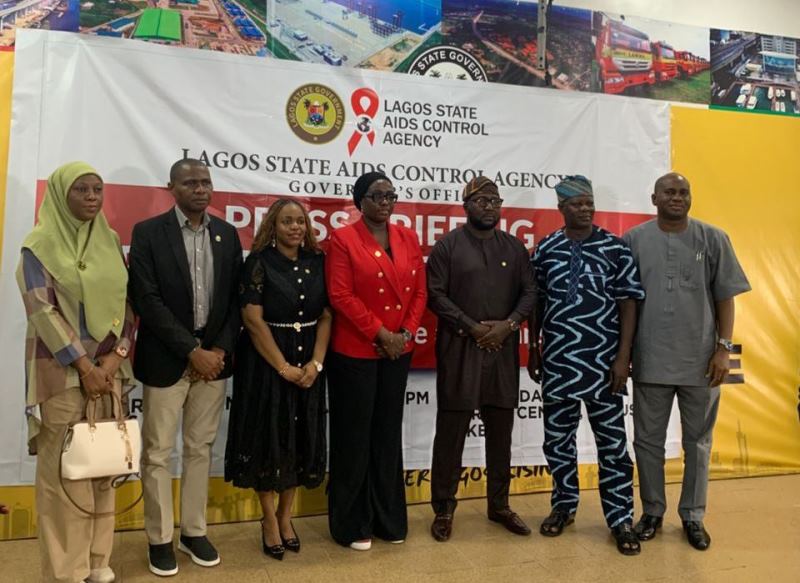
The Lagos State Government has moved to correct what it describes as a misinterpretation of recent HIV data, while simultaneously announcing a landmark initiative that positions the state as the first sub-national government in Nigeria to independently procure antiretroviral medicines.
Dr. Folakemi Animashaun, Chief Executive Officer of the Lagos State AIDS Control Agency (LSACA), addressed journalists at the Bagauda Kaltho Press Conference Centre in Alausa, Ikeja, on Thursday, providing what she termed “factual clarification” regarding media reports that suggested Lagos recorded the highest number of new HIV infections in Nigeria during 2025.
“The figure widely reported in the media requires important technical interpretation. It does not literally translate to the State recording 10,430 new HIV infections in 2025,” Dr. Animashaun stated.
“The number that has been widely circulated refers to newly diagnosed HIV-positive cases, not necessarily new HIV infections that occurred within the year. These are two very different public health indicators,” she added.
Animashaun explained that a newly diagnosed HIV-positive case simply confirms an individual was found to be HIV-positive during the reporting period, and may include persons who acquired the virus several years earlier but were only recently tested.
The figure, she noted, could also encompass individuals who travelled to Lagos for testing or treatment, referrals from other states, and people identified because of the state’s expanded access to HIV testing services.
“This distinction is critical because inaccurate interpretation of public health data can generate unnecessary fear, increase stigma and discrimination, discourage HIV testing, and ultimately undermine public health interventions,” she said.
The LSACA Chief Executive emphasised that Lagos State, as Nigeria’s most populous state and its commercial and healthcare hub, naturally records some of the highest volumes of HIV testing, diagnosis, treatment, and patient referrals.
She argued that stronger surveillance systems and wider access to healthcare services invariably result in higher case detection and should not be misconstrued as evidence of worsening epidemic control.
Available programme data, Animashaun said, demonstrate sustained progress in HIV control across the state, saying that in 2025, Lagos conducted 504,800 HIV tests, through which 11,940 HIV-positive cases were identified, representing a positivity yield of 2.4%.
“In the first quarter of 2026, the state conducted 179,229 HIV tests, identifying 3,390 HIV-positive cases, while the positivity yield further declined to 1.9%.
“The declining positivity rate, despite expanded testing, is a significant epidemiological indicator that reflects improving epidemic control,” she noted.
“As of 2025, 147,904 persons were receiving antiretroviral therapy across Lagos State, with 97% achieving viral suppression. The Early Infant Diagnosis positivity rate has declined remarkably from 5.1% in 2020 to 1.5% in 2025, reflecting sustained improvements in maternal and child HIV services.
“The available programme data do not support panic. Rather, they underscore the strength of Lagos State’s surveillance system, expanded access to HIV services, and sustained progress towards epidemic control,” Animashaun added.
In what she described as a “bold and unprecedented step,” the Lagos State Government has directly procured antiretroviral drugs to support uninterrupted HIV treatment services across the state.
“The first consignment of these state-procured ARV medicines is expected to arrive in Lagos by the end of August 2026.
“This marks a historic milestone, making Lagos State the first sub-national government in Nigeria to independently procure antiretroviral medicines for people living with HIV,” Animashaun announced.
“This landmark initiative demonstrates the unwavering commitment of Mr Governor, Mr Babajide Olusola Sanwo-Olu’s administration to safeguarding the health of Lagos residents, reducing dependence on external donor support, and ensuring uninterrupted access to life-saving HIV treatment.”
The LSACA Chief Executive explained that the initiative lays the foundation for a more sustainable, resilient, and state-owned HIV response, reflecting Lagos State’s determination to secure long-term HIV commodity security and preserve the gains achieved in HIV prevention, treatment, and care over the past two decades.
Furthermore, she disclosed that the state is exploring opportunities to strengthen local health security through sustainable antiretroviral commodity production, leveraging international best practices and lessons from Kenya’s pharmaceutical and health commodity management experience, while collaborating with global partners such as UNAIDS.
Animashaun also noted that the state is currently implementing HIV prevention interventions, including HIV Pre-Exposure Prophylaxis (PrEP), both oral and long-acting injectable forms.
Addressing Lagos residents directly, she said: “There is no cause for panic. Know your HIV status, access available prevention, testing, treatment, and care services, rely only on verified public health information, and reject every form of stigma and discrimination. HIV remains preventable and manageable. With early diagnosis and sustained treatment, people living with HIV can live long, healthy, productive, and fulfilling lives.”