By Amofokhai Williams
The National Agency for Food and Drug Administration and Control (NAFDAC) has issued a public alert on the circulation of falsified batches of Postinor-2 (Levonorgestrel 0.75mg), a widely used emergency contraceptive pill.
In a statement, NAFDAC disclosed that the fake products were flagged following a report from the Society for Family Health (SFH), the authorised marketing authorisation holder, which confirmed that it had not imported the affected batches.
“The National Agency for Food and Drug Administration and Control (NAFDAC) hereby notifies the public of falsified Type 1 and 2 batches of Postinor-2 in circulation,” the agency said.
How to Spot the Fake
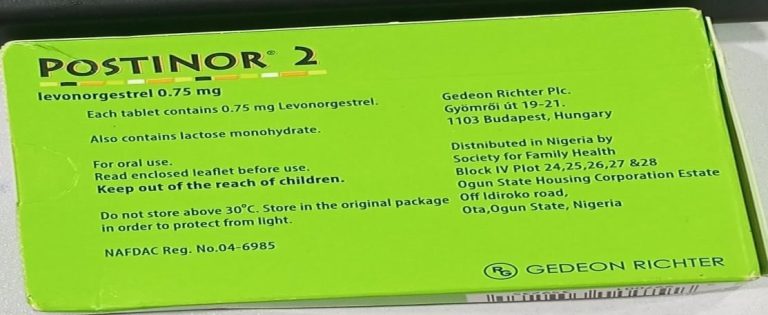
According to the agency, the counterfeit packs bear noticeable errors. These include: Smaller font size on the pin verification sticker, with “Veify” misspelt instead of “Verify” (Type 1).
A spelling error on the back of the pack: “Distnibuted in Nigeria” instead of “Distributed in Nigeria.”
Mismatched product details, including inconsistent batch numbers and expiry dates.
The original product (Batch No: T32458H, Mfg. Date: 02/2023, Exp. Date: 02/2027, NRN NO: 04-6985) differs significantly from the falsified versions (Batch No: T36184B, Exp. Date: 08/2028, and Batch No: 332, Exp. Date: 02/2027).
Health Risks
NAFDAC warned that the falsified contraceptives could contain substandard or toxic substances, incorrect dosages of levonorgestrel, or contaminants from non-sterile conditions.
“The risks of administering falsified Postinor-2 include contraceptive failure, toxic side effects, long-term reproductive health complications, allergic reactions, organ damage, or even death,” the agency noted.
Regulatory Response
All NAFDAC zonal directors and state coordinators have been directed to conduct surveillance and mop up the counterfeit products across the country.
The agency also urged stakeholders in the supply chain—distributors, pharmacists, retailers, and healthcare providers—to exercise vigilance.
“All medical products must be obtained from authorised suppliers, and both authenticity and packaging should be carefully checked,” it stressed.
NAFDAC appealed to healthcare professionals and the public to report suspected cases of fake medicines through its toll-free line 0800-162-3322, email sf.alert@nafdac.gov.ng
, or via its official website www.nafdac.gov.ng.