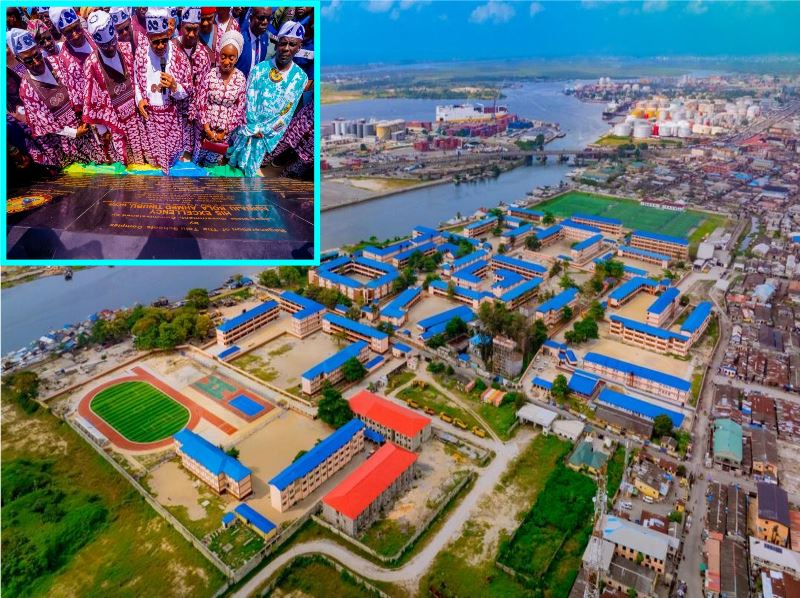
President Bola Ahmed Tinubu has inaugurated the remodelled Tolu Schools Complex in Ajegunle, Lagos, described as Africa’s largest integrated educational community, alongside the unveiling of 19 mini-football pitches at the adjoining Maracana Stadium.
The landmark projects, delivered by Governor Babajide Sanwo-Olu, were part of activities marking the President’s second-day visit to Lagos. Tinubu was represented at the ceremony by Senate President Godswill Akpabio.
Situated on 11.73 hectares in Ajeromi-Ifelodun Local Government Area, the Tolu Schools Complex comprises a cluster of 36 public schools that have undergone comprehensive rehabilitation under an infrastructure renewal programme supervised by the Special Committee on Rehabilitation of Public Schools (SCRPS).
The facility now integrates primary, junior and senior secondary schools, forming a complete academic ladder, while accommodating tens of thousands of students in a significantly improved learning environment.
Describing the project as “exceptional and remarkable,” Tinubu said the scale of transformation reflects purposeful leadership and a strong commitment to improving the lives of young Nigerians.
“The remarkable scale and significance of Tolu Schools Complex regeneration is truly exceptional. The successful upgrade of such a large and complex educational facility is highly commendable. This reflects the vision, planning and very clear commitment to improving the lives of our young citizens,” he said.
He stressed the need for sustained investment in education as a driver of economic growth and national development.
“We must continue to invest in education, not just as a social service but as driver of economic growth and national development. When we equip our children with knowledge and skills, we prepare them to contribute meaningfully to society and compete in a changing world,” the President added.
Tinubu noted that his administration’s Renewed Hope Agenda prioritises access to quality education and practical skills development, aimed at preparing young Nigerians for a modern, competitive economy.
Governor Sanwo-Olu described the project as a bold reimagining of public education in Lagos, stating that the intervention went beyond cosmetic upgrades to deliver a complete transformation of the historic complex.
“We took a clear and deliberate decision to regenerate this historic complex completely and courageously. What we are commissioning today is not a facelift or a cosmetic intervention. It is a full re-imagination of what public education should look like in a modern African city,” he said.
He disclosed that the redevelopment included 12 new classroom blocks with 18 classrooms each, rehabilitation of 24 existing buildings, and the construction of a four-storey vocational and skills acquisition centre to bridge the gap between academic learning and practical competence.
The complex also features a central science laboratory and ICT hub capable of accommodating 200 students at a time, designed to enhance digital learning and scientific research.
Sanwo-Olu further revealed that the Maracana Stadium, comprising 19 mini-football pitches, has been renamed after President Tinubu in recognition of his support for youth and sports development.
In addition to the school project, Tinubu virtually commissioned the Abijo Mid-Level Fresh Food Hub in Eti-Osa, a 23,000-square-metre facility designed to improve food distribution, storage and accessibility across the Lekki-Ajah corridor.
“This facility, with its modern storage infrastructure, trading floors, and logistics systems, will decentralise access to fresh produce beyond our traditional markets,” Sanwo-Olu said.
Minister of Education, Tunji Alausa, described the project as a landmark achievement that reflects purposeful leadership and a strong commitment to educational excellence.
“The commissioning of Tolu Schools Complex is a landmark achievement in our collective pursuit of educational excellence. This is an unveiling of a bold statement and declaration that Nigeria is investing decisively in the future of its children,” he said.
The project is expected to significantly ease overcrowding, improve learning conditions and expand access to quality education in one of Lagos’ most densely populated communities, reinforcing the state’s drive towards human capital development and inclusive growth.