

By Amofokhai Williams
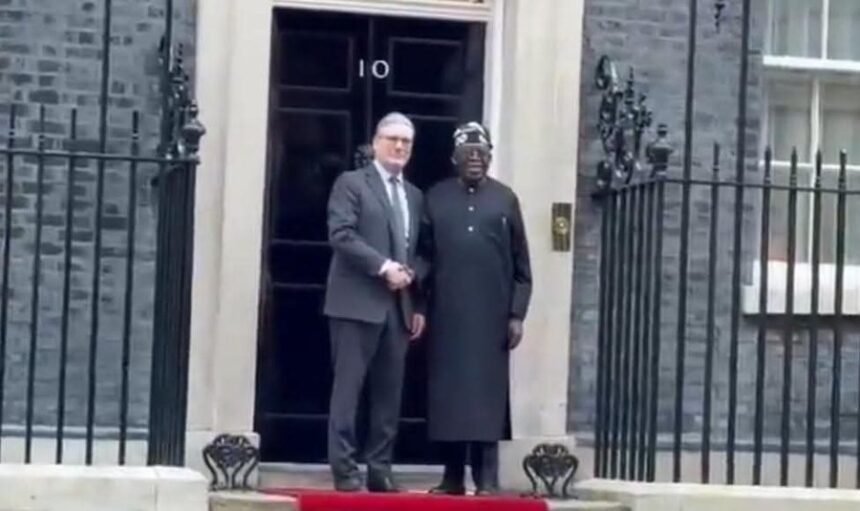
President Bola Tinubu met with British Prime Minister Keir Starmer at 10 Downing Street on Thursday for a closed-door bilateral engagement, shortly before witnessing the signing of a landmark £746 million financing agreement to overhaul Nigeria’s two busiest maritime gateways .
The deal, finalised between UK Export Finance (UKEF), the Nigerian Ports Authority, and the Federal Ministry of Finance, will fund the comprehensive refurbishment of the Lagos Port Complex (Apapa Quays) and the Tin Can Island Port Complex.
When asked by reporters about the outcome of his meeting with Starmer, Tinubu offered a terse but optimistic response: “Very good.”
The signing represents the commercial centrepiece of Tinubu’s three-day state visit to the United Kingdom-the first by a leader of a West African nation in 37 years and the first by a Muslim leader during Ramadan in nearly a century.
On Wednesday, King Charles III and Queen Camilla hosted the Nigerian president and First Lady Remi Tinubu at a spectacular state banquet at Windsor Castle, where special accommodations were made for the fasting president, including a designated prayer room.
Under the agreement, UKEF has guaranteed loans arranged by Citibank to fund the port modernisation project, with a critical condition requiring that at least 20% of supplier contracts, amounting to a minimum of £236 million, be sourced from British companies.
The most significant beneficiary is British Steel, which has secured a £70 million contract to supply 120,000 tonnes of steel billets to Nigerian construction firms Hitech Nigeria and ITB Nigeria.
This represents the company’s largest-ever export order backed by UKEF and follows the UK government’s newly announced Steel Strategy.
British Steel CEO Allan Bell hailed the development as transformative for the company’s 4,000 employees. “This deal represents us moving from stabilisation to building long-term sustainability for the business,” he said.
Business and Trade Secretary Peter Kyle described the agreement as “a major win for British Steel” that would “reinforce British Steel’s world-class expertise while supporting jobs and growth in Scunthorpe” .
For Nigeria, the project addresses decades of infrastructure neglect at facilities that handle more than 70% of the nation’s imports and exports. The Lagos Port Complex dates to 1913, while Tin Can Island Port was commissioned in 1977, neither having undergone comprehensive modernisation of this scale in nearly 50 years .
Nigerian Minister of Marine and Blue Economy Adegboyega Oyetola outlined ambitious transformation targets, projecting sharp reductions in vessel turnaround times and cargo dwell periods as automated systems replace paper-based procedures .
“The modernisation and upgrading of Nigeria’s ports represents a major step forward for the country and aligns closely with the Federal Government’s commitment to unlocking the full potential of the marine and blue economy,” Oyetola said.
The project combines physical infrastructure expansion with digitalisation initiatives, including plans to launch a National Single Window platform by the end of March to streamline port procedures.
Officials aim to eliminate chronic congestion that has historically diverted traffic to competing regional hubs such as Cotonou, Lomé, and Tema.





Eku ise sir Mr President